

TL;DR – Quick Troubleshooting Summary
When your garage door refuses to close, automatic safety features or mechanical jams are usually to blame. Here are the 5 most common reasons and their quick fixes:
- Blocked or Misaligned Safety Sensors: The #1 cause. Clean dust off the photo-eye lenses and align the sensors so indicator lights shine solid.
- Incorrect Travel Limit Settings: Adjust the opener motor’s down-limit screws so it knows exactly where the floor is.
- Track Obstructions or Bends: Clear dirt, leaves, and cobwebs from side tracks, and inspect steel channels for dents or bends.
- Active Wall Console Lock Mode: Check if the lock button on your interior wall control was accidentally activated.
- Broken Springs or Snapped Cables: If the door moves a few inches and stops with a loud strain, a broken spring may have destroyed the weight balance.
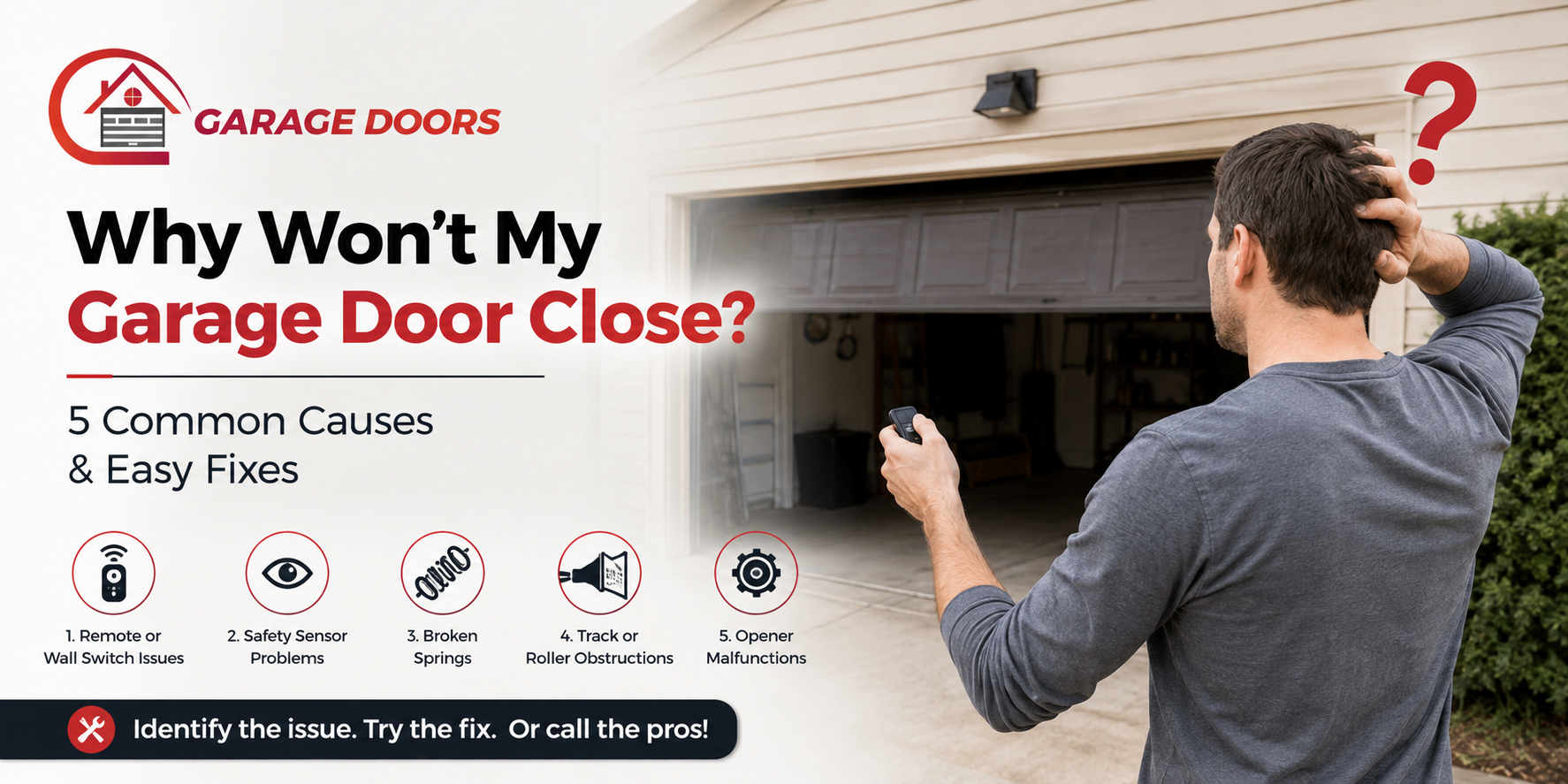
Few home disruptions are as frustrating as pulling out of your garage in the morning, hitting your remote button, and watching the garage door start to descend—only to stop, reverse immediately, and flash its opener light at you. You are left standing there with an open garage and a home exposed to security risks and weather.
Because garage doors rely on intricate safety mechanisms designed to protect children, pets, and vehicles, even a minor sensor obstruction or travel miscalculation will prevent the door from closing. At Garage Doors in Omaha, we walk homeowners through step-by-step troubleshooting to help pinpoint why your door won’t shut and how to fix it safely.
1. Misaligned, Dirty, or Blocked Safety Photo-Eyes
By federal safety law mandated by the U.S. Consumer Product Safety Commission (CPSC), all automatic garage door openers installed since 1993 must feature photoelectric safety sensors located 4 to 6 inches above floor level on both sides of the door tracks.
The Problem:
One sensor sends an invisible infrared beam to the receiving sensor across the doorway. If that beam is broken by an object—or interrupted by dirty lenses, cobwebs, leaf debris, or direct sunlight blinding the sensor—the opener system assumes something is under the door and automatically forces it to reverse.
The Fix:
- Clear the Path: Remove lawnmowers, brooms, boxes, or stray leaves hanging around the bottom tracks.
- Wipe the Lenses: Clean both glass photo-eye lenses using a soft microfiber cloth and mild glass cleaner.
- Check the LED Lights: Look at the small LED indicator lights on both sensors. If one light is flickering or completely dark, gently loosen the mounting bracket wing nut, pivot the sensor until the light stays solid green or amber, and retighten the bracket.
2. Incorrect Travel Limit Settings
If your garage door closes almost all the way to the pavement, touches the floor briefly, and immediately reverses back up into the fully open position, your travel limit settings are likely out of adjustment.
The Problem:
The travel limit settings on your garage door opener tell the electric motor how far down the door needs to travel before coming to a complete rest. If the “close limit” is set too far down, the door hits the concrete floor, interprets the ground pressure as an obstacle, and triggers its safety reversal mechanism.
The Fix:
Locate the travel limit adjustment screws on the side or back of your motor housing (labeled “Up Limit” and “Down Limit”). Using a flathead screwdriver, turn the “Down Limit” screw counter-clockwise in small quarter-turn increments. This reduces how far down the motor pushes the door, allowing the bottom seal to rest flush against the driveway without triggering an auto-reversal.
3. Bent Tracks or Mechanical Track Obstructions
A garage door requires smooth, uninhibited track channels to travel down safely. If physical friction becomes too intense, the motor cuts power as a safety precaution.
| Symptom Observed | Root Cause | Recommended Action |
|---|---|---|
| Door stops midway and binds | Hardened grease buildup or pebbles trapped inside vertical track curve. | Scrape away dried grease inside tracks and wipe clean with a rag. Lubricate rollers. |
| Door squeals & sticks at one point | Track section is dented, pinched, or knocked out of plumb alignment. | Tap small dents out gently with a rubber mallet or call a tech to realign track verticality. |
4. Activated Wall Console Lock Feature
Sometimes the simplest explanation is the right one. If your wall-mounted control button operates the door light but your wireless remotes and keypad refuse to close the door, check your wall console lock switch.
The Problem:
Most modern wall consoles feature a manual “Lock” or “Vacation” button. When pressed, this feature disables all wireless radio frequency signals from remotes and car keyfobs to prevent unauthorized access while you are away from home.
The Fix:
Press and hold the “Lock” button on your main wall button console for 3 to 5 seconds until the indicator light stops blinking and stays solid green. Test your remote control again to confirm signal restoration.
5. Broken Counter-Balance Springs or Cables
If your garage door opens only 2 to 6 inches off the ground and stops, or refuses to move downward despite the motor humming loudly, you may have a broken spring or snapped lift cable.
Critical Safety Warning:
Never force an electric opener to push down a garage door with a broken spring. Residential garage doors weigh 150 to 300+ pounds; attempting to operate a door without working counter-balance springs will strip opener motor gears, snap trolley drive belts, and cause structural panel buckling under guidelines managed by DASMA safety standards.
When to Call for Professional Garage Door Assistance
While clearing safety sensors, adjusting limit screws, and turning off vacation lock modes are easy DIY tasks for homeowners, resolving structural track misalignment, cable off-spooling, or broken spring repairs requires specialized heavy-duty tools and mechanical expertise.
If your door remains stuck open or continues to malfunction after basic sensor troubleshooting, schedule a rapid-response garage door repair with our certified local technicians to restore your door’s safety and operational reliability.
Frequently Asked Questions (FAQ) about Closing Garage Door Issues in 2026
Why does my garage door close using the wall button but not the remote?
Holding down the interior wall button overrides the photoelectric safety sensor system in an emergency. If your wall button works only when held continuously, but your remote won’t close the door at all, your safety sensors are either misaligned, dirty, or dealing with damaged wiring.
Can bright sunlight prevent my garage door from closing?
Yes. Direct sunlight hitting the receiving photo-eye lens at a specific angle can blind the infrared sensor beam. You can fix this by swapping the placement of the sender and receiver sensors so the receiving lens faces away from direct morning or evening sun glare, or by installing small cardboard sensor sunshades.
Why is the light bulb on my garage door opener flashing?
A flashing opener light bulb is a diagnostic code indicating a safety reversal event. On most Chamberlain, LiftMaster, and Craftsman openers, 10 continuous flashes signal that the safety sensors are misaligned, obstructed, or disconnected.
How do I manually close my garage door if the opener fails?
Pull the red emergency release cord hanging from the overhead motor trolley while the door is in the fully open position. Gently lower the door down manually by hand. Make sure to lower it slowly, especially if a spring is broken, as the door will feel extremely heavy.