

TL;DR – Quick Comparison Overview
Garage door springs perform the heavy lifting required to open 150-to-300-pound doors easily. Understanding which type powers your door system comes down to location and mechanics:
- Torsion Springs: Mounted horizontally above the garage door header. They twist to store energy, offer smooth and quiet operation, last 10,000 to 20,000 cycles, and contain broken coils safely on a center steel shaft.
- Extension Springs: Mounted on the sides parallel to the overhead tracks. They stretch to store energy, are cheaper upfront, last 5,000 to 10,000 cycles, and require internal safety cables to prevent flying debris when they break.
- The Verdict: Torsion springs are safer, longer-lasting, and exert less strain on your electric opener motor. Converting from extension to torsion is a highly recommended upgrade.
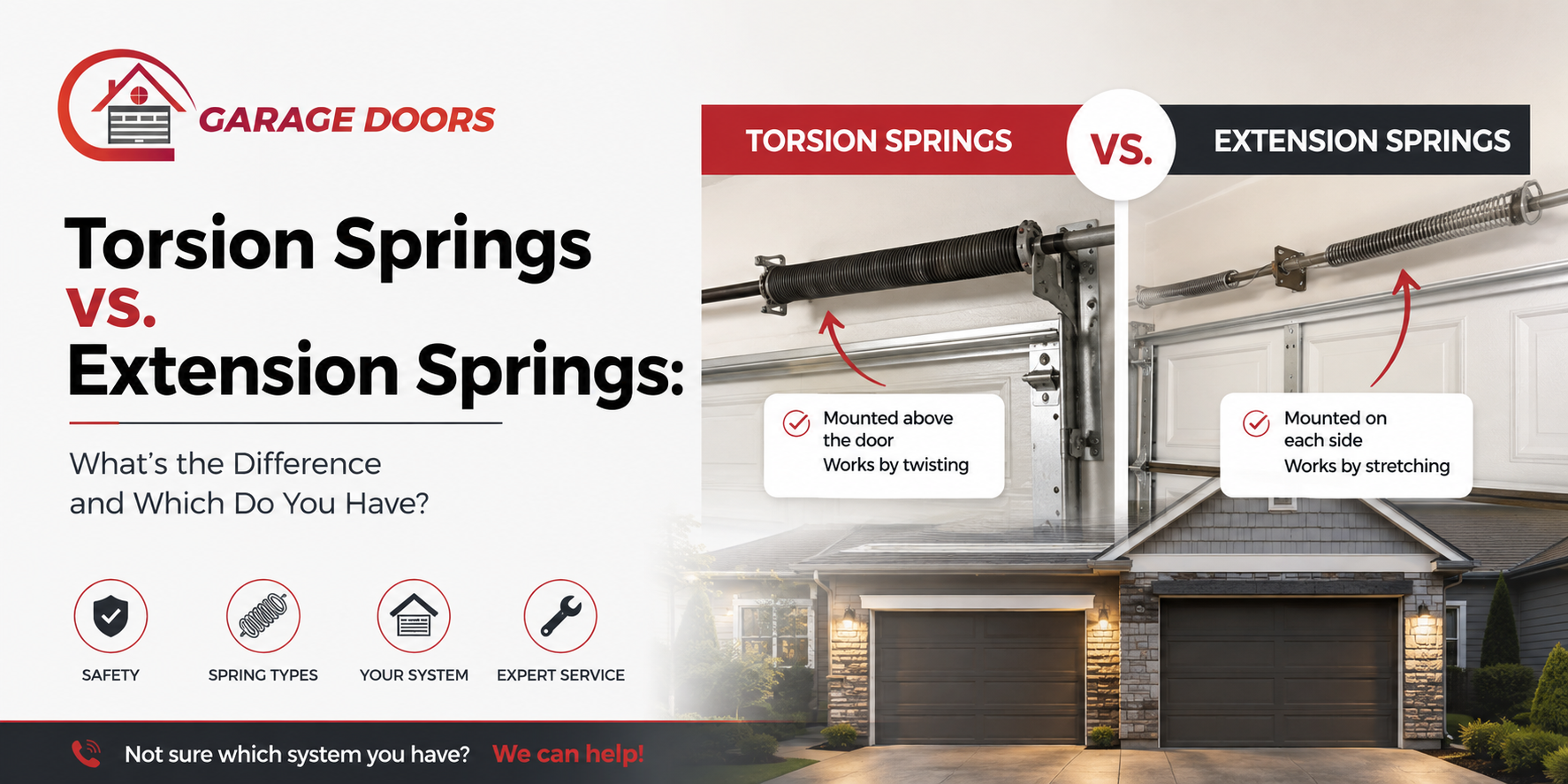
When you press your garage door remote button, the electric motor doesn’t actually lift the door’s full weight on its own. Instead, heavy-duty steel counter-balance springs do 90% of the heavy lifting. The motor simply acts as the driver that guides the door along its tracks.
Because these springs sustain immense mechanical pressure daily, knowing whether your home utilizes torsion springs or extension springs is vital for maintenance, safety, and troubleshooting. At Garage Doors in Omaha, we help local homeowners identify their spring setup and keep their doors operating safely year-round.
Understanding Torsion Springs: The Modern Standard
Torsion springs are heavy steel coils mounted horizontally on a metal shaft directly above the top header of your garage door frame.
How They Work:
Rather than stretching out, torsion springs use rotational torque force. When the door closes, heavy cable drums at the ends of the center shaft wind up the springs, storing immense rotational energy. When opening, that twisted coil releases torque to turn the shaft, spooling the lift cables and smoothly pulling the door upward.
Key Advantages of Torsion Springs:
- Longer Lifespan: Standard torsion springs are rated for 10,000 to 20,000 open/close cycles (roughly 8 to 15 years of normal use). Extended-life options can reach up to 50,000 cycles.
- Controlled Safety: If a torsion spring snaps due to metal fatigue, it stays contained on the central steel tube shaft with a loud pop, preventing metal fragments from whipping around the garage.
- Smoother Balance: Torsion systems distribute door weight evenly across both sides, placing far less mechanical strain on your automatic opener motor and track rollers.
Understanding Extension Springs: The Budget Option
Extension springs are long, tightly wound metal coils installed above the upper horizontal tracks on both the left and right sides of your garage door.
How They Work:
Extension springs function by expanding and stretching linearly. As the garage door descends, the springs stretch out along the tracks, storing potential energy. When the door lifts, the springs contract back to their baseline length, helping pull the door panels overhead.
Drawbacks to Consider:
- Shorter Lifespan: Extension springs generally last between 5,000 and 10,000 cycles (roughly 4 to 7 years), requiring more frequent replacement.
- Increased Safety Hazard: Because extension springs stretch under high tension without a central shaft holding them, a snapping spring can launch heavy steel shards across your garage unless safety cables are properly threaded inside the coil.
- Uneven Wear: Extension springs pull independently on each side of the door. As one spring weakens faster than the other, the door can wobble or binding can occur along track channels.
Torsion Springs vs. Extension Springs: Comparison
Here is a side-by-side feature comparison between the two primary spring configurations:
| Feature | Torsion Springs | Extension Springs |
|---|---|---|
| Mounting Position | Above top door opening frame | Parallel to horizontal side tracks |
| Mechanical Motion | Twisting / Torque force | Stretching / Linear extension |
| Average Lifespan | 10,000 – 20,000+ Cycles | 5,000 – 10,000 Cycles |
| Required Safety Cable? | No (Shaft holds spring in place) | Yes (Essential safety component) |
| Operation Smoothness | Ultra-smooth and quiet | Can jerk or wobble as coils stretch |
| Initial Cost | Slightly higher upfront cost | Lower upfront cost |
How to Identify Which Springs Your Garage Door Has
You can identify your spring setup in seconds with a simple visual check inside your garage:
- Look Above the Closed Door: If you see one or two thick steel coils wound tightly around a long metal bar mounted right above the door opening, you have a torsion spring system.
- Look Along the Upper Side Tracks: If you see long, thin springs stretched horizontally along the ceiling tracks running back into the garage depth, you have an extension spring system.
Critical Safety Warning:
Never attempt to loosen, adjust, or untighten spring winding cones or bottom lift brackets yourself. Counter-balance springs hold enough stored kinetic force to cause severe personal injury or property damage. Safety standards set by the Door and Access Systems Manufacturers Association (DASMA) mandate that high-tension spring services should only be performed by certified door technicians using proper winding tools.
Should You Convert from Extension to Torsion Springs?
If your current extension springs break or show signs of severe rust, converting to a modern torsion spring conversion kit is one of the smartest investments you can make for your home.
A torsion conversion replaces worn side springs, end bearing plates, lift cables, and drums with a centralized torsion tube system. This upgrade delivers quieter operation, eliminates side-to-side door wobbling, prolongs electric opener lifespan, and protects family members against dangerous spring snaps. Industry safety tests from publications like Consumer Reports consistently favor torsion spring systems for modern residential reliability.
To inspect your current counter-balance system or upgrade your home to a long-lasting torsion spring setup, schedule a comprehensive garage door installation with our team of local specialists.
Frequently Asked Questions (FAQ) for Torsion vs Extension Springs in 2026
Can my garage door open with a broken spring?
You should never try to open a garage door with a broken spring. Without spring counter-balance support, your electric opener will attempt to lift the door’s unassisted weight (150–300+ lbs), which can burn out opener gears, bend top door panels, or snap drive belts.
Should I replace both garage door springs at the same time?
Yes. Garage door springs are installed at the same time and undergo the exact same number of opening cycles. When one spring breaks from metal fatigue, the companion spring has experienced identical wear and will typically fail shortly after. Replacing both together saves on service call costs and prevents double downtime.
What does a broken garage door spring sound like?
When a garage door spring snaps, it releases all its stored energy in a fraction of a second. This generates a loud bang that sounds like a gunshot or a heavy firecracker echoing from inside your garage.
How often should garage door springs be lubricated?
You should apply a light coat of silicone or lithium-based spray lubricant to spring coils every 6 months. Keeping spring coils lubricated prevents surface rust friction and extends overall steel cycle life.